.png)


monday.com AI Feature Prioritisation: Can You Create AI-Driven Product Strategies for Risk Detection in 2026?
- Ishani Dhar Chowdhury

- Apr 20
- 7 min read
Can monday.com AI feature prioritisation support automations in agile planning and product risk management?
With monday.com AI feature prioritisation, you can embed intelligence directly into the development lifecycle to transform product risk management.
The monday Dev AI performs by analysing market trends, user behaviour, competitive data, and more. It'll predict feature impact, helping teams to make data-driven prioritisation aligned with OKRs.
monday Work Management enables portfolio-level risk visibility for detection. The AI does this by scanning project boards, providing actionable context, and prioritising risks by urgency.
Beyond that, AI Blocks automate repetitive tasks, categorise project data, and flag scheduling conflicts to support agile planning automations. This feature can also identify bottlenecks before they arise.
All in all, monday.com AI-powered capabilities will suggest optimal resource allocations by spotting risks early and monitoring progress. As a result, it enables product teams to build faster, smarter, and more predictably.

Imagine this: AI flags risks before they can derail your next sprint. How would your product strategy be if that happened?
With monday.com AI feature prioritisation, that's no longer a hypothetical question. This will ensure your development team is ahead of potential failure points.
Even then, 51% of organisations have faced a negative consequence while using AI. Issues lie in inaccuracy and risk-explainability. This proves that reactive product risk management is no longer enough.
Thankfully, product leaders using monday AI for product risk management will have clear opportunities. They'll embed intelligence directly into their development lifecycle.
How will this help? Well, it automates risk detection, keeps agile planning automation, shows score feature backlogs with precision, and more.
In this blog post, we'll explore how monday AI capabilities are redefining product risk management strategies.
Why Don't Traditional Product Risk Management Processes Work?

Product teams are venturing into uncharted territory. They're operating under a fundamentally different set of pressures.
Due to high demand, delivery cycles have become shortened. However, stakeholder expectations have grown.
The volume of incoming feature requests has also blown beyond the ways the manual triage process handles. The old model is no longer viable. That used to leave teams catching up to failed data.
Gone are the days of periodic risk reviews, retrospective problem-solving, and gut-feel prioritisation. The failure points include the following:
Features are prioritised based on who spoke the loudest in the last planning meeting.
Product managers spend more time compiling status reports than making strategic decisions.
Delivery risks sit invisible in sprint data until the deadline slips.
Backlog refinement relies on individual judgment and not cross-functional data.
How Can monday AI Help?
Enter monday AI feature prioritisation to change the equation. This platform doesn't treat risk as 'something to address after a sprint goes wrong.'
Instead, monday WorkOS embeds intelligence directly into the product management lifecycle. This ensures that risks get surfaced before they can escalate.
monday AI also shifts work management from 'reacting to problems to predicting them.' With this feature, your product team can spot risks and bottlenecks before they impact delivery.
In fact, 86% of global executives have already deployed AI to enhance revenue. IT professionals have also started to use automations for data management.
Such intelligence-led workflows are no longer optional if you want your product team to be competitive. monday.com product risk management with AI addresses each of the failure points systematically.
Teams adopting this will move forward with data-driven evidence. Organisations that still rely on spreadsheets and manual workflows will never know the power of automation with monday.com agile planning.
Remember, the gap between AI-equipped competitors will widen with every sprint.
Can monday.com AI Feature Prioritisation Rank and Score Backlogs?

monday.com's approach to AI-assisted feature prioritisation centres on reducing subjective decision-making. That'll be through data-backed recommendations.
The platform aims to surface objective signals about feature impact by analysing user behaviour and work data. It'll help the product managers move from debating priorities to acting on them.
For example, AI Blocks are central to how this works. When set up on a monday Board, this feature automatically handles data-intensive and repetitive tasks.
In monday Dev, these AI Blocks can help with backlog management. They'll sort out and categorise incoming requests. This will help teams stay on top of high-volume feedback.
It will adapt to your business framework through customisable fields, scoring formulas, and more. monday AI in Dev allows teams to layer criteria on these methods.
Capabilities of monday AI Feature Prioritisation in Dev
After you enable AI tooling, it can assist in refining scores and applying them. However, the degree of automation will vary by plan and configuration.
Relevant capabilities within monday AI include the following:
Automated backlog categorisation: AI can tag and sort incoming items, reducing manual assessments.
Framework-aligned scoring: Teams can configure scoring against business outcomes (including OKRs) using monday Dev's customisable fields.
Trade-off visualisation: Product managers can compare features across multiple criteria simultaneously.
Feedback theme clustering: AI tooling can group user feedback into patterns, helping surface recurring needs.
When it comes to product risk management with AI, this scoring layer adds value during the early stages of the process. Development features with conflicting dependencies and unclear scope can be identified during prioritisation (and not mid-sprint).
All that shifts your team from reactive backlog management toward strategic and deliberate planning.
Proactive Risk Detection in Agile Teams: Use Data About Sprint Velocity
What's the most underused asset in any agile team? That'll be the sprint history.
According to ResearchGate, only 67% of agile teams reported quicker project resolution rates. That's because most of them don't analyse the detailed sprint history records.
Every completed sprint will leave behind estimation accuracy, velocity fluctuation, dependency performance, and workload distribution. Most teams end up archiving this data.
Thankfully, monday Dev AI will turn this historical record into a forward-looking risk engine. It'll analyse team velocity to suggest realistic sprint commitments.
Development teams can also get automated alerts, notifying them when velocity deviates from normal patterns. This transforms sprint planning from negotiation to a data-led commitment.
High-Impact Areas for Predictive Capability in Agile Planning
monday Dev pulls backlog priorities, capacity planning, and past performances into one dashboard. Agile teams will benefit in the following areas:
Velocity trend analysis: AI monitors sprint-over-sprint performance and flags when a team is trending toward overcommitment.
Dependency risk identification: Cross-team blockers are surfaced before they interrupt active sprints.
Capacity forecasting: Workload is balanced against each team member's historical throughput, not just their stated availability.
Unplanned work tracking: The ratio of planned versus unplanned tasks is monitored automatically, revealing planning accuracy over time.
Product leaders get a clear line of sight from everyday velocity data (today to next quarter's delivery commitments). All that agile planning automation leads to fewer sprint failures and more reliable release forecasting.
Measuring ROI: AI-Driven Product Strategy and Risk Detection
IBM revealed that 74% of businesses report moderate or limited coverage in AI risk and governance frameworks. This exposes an underlying problem. There's a critical gap between rapid AI adoption and mature oversight structures.
That's why implementing monday.com AI feature prioritisation is a strategic investment. This will ensure product risk management with AI for measurable returns.
monday AI generates ROI across multiple trackable dimensions. Therefore, the key metrics include:
Reduction in project cycle time.
Decrease in budget variances.
Risk mitigated before impact.
KPIs that demonstrate ROI.
Performance Indicators Across Agile Planning
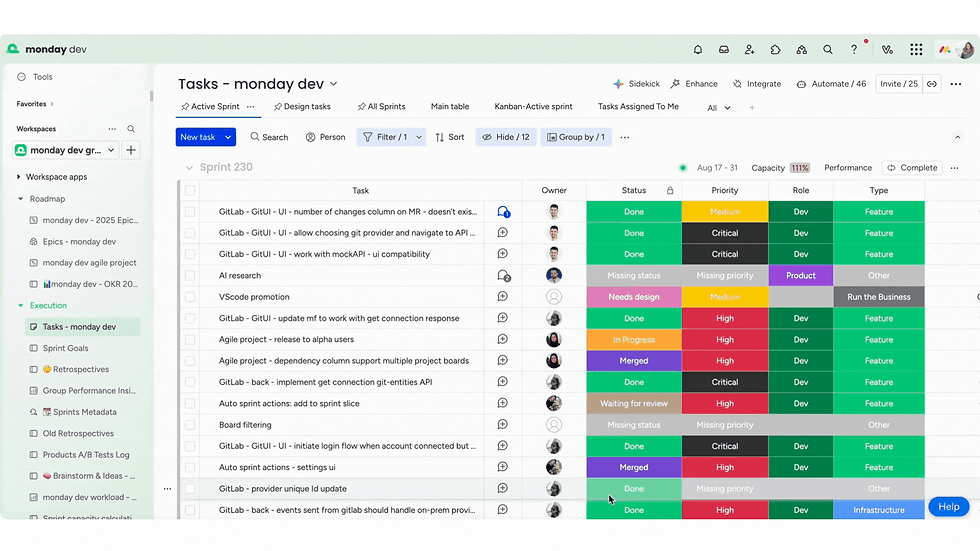
Consider monday AI as a digital workforce to guide meaningful workflows for your product teams. The KPIs for agile planning automation include the following:
Sprint predictability rate: Team delivery consistency against the committed scope.
Analysis time saved: AI-powered dashboards automatically surface hidden opportunities and predict risks. About 30% of the analysis time is saved for your team.
Risk-to-resolution time: Quick risk flagging for issue identification and ownership to address before impacting delivery.
Backlog accuracy: The percentage of prioritised features that align with actual business outcomes upon release.
Unplanned work ratio: Tracked automatically through monday Dev's Agile Insights. This reveals how reactive issue-solving is replacing strategic delivery.
All in all, the monday AI capabilities help teams cut manual work by 50%. This saves time and reduces errors.
Remember, product risk management without AI can no longer be measured. In turn, it cannot be sustained. Product leaders will need monday WorkOS's reporting infrastructure and proper AI adoption.
To End With
Shifting from reactive to predictive product management has become a baseline expectation. Reports suggest that AI will eliminate about 80% of current project management tasks by the end of 2030.
With monday AI feature prioritisation, you can transform how data is tracked, reported, and collected. Your team will lead only when they stop treating risk detection as a retrospective exercise.
By embedding monday AI for product risk management and agile planning automation, you can transform product strategies into a data-driven excercise. monday Work Management and Dev make this transition accessible, scalable, and measurable.
Are you ready to put monday AI capabilities to work for your product team? With Fruition's help, you can do just that.
Being a monday Platinum Partner and Advanced Delivery Partner, we specialise in end-to-end implementation, product management consulting, and AI strategy. We will help businesses get the maximum value using the monday platform from day one.
FAQs
Do monday AI features require technical expertise to set up?
No, you won't need any technical expertise to set up the monday AI features. These capabilities are available across all paying accounts. You'll benefit from built-in tools and unique no-code AI Blocks, Digital Workforce, and Product Power-Ups.
How does monday.com measure AI credits?
A paid plan in monday WorkOS comes with a free trial of AI credits. Non-enterprise accounts get 6,000 credits, and enterprise accounts have 12,000 credits. You'll also get usage trackability directly into the Administrative section under Usage Stats.
Do you get monday AI Workflows in all plans?
AI Workflows in monday are available only in the Pro and Enterprise plans. It gives teams multi-step intelligent automations built directly into existing boards and processes.


